
Why Strumming Patterns Matter
Most beginners spend weeks learning chords, then wonder why their playing still doesn't sound like an actual song. Nine times out of ten, the missing piece is the right hand. Chords are the what. The guitar strumming pattern is the feel. It's the difference between a stiff, robotic chord change and something that actually grooves.
I started on the ukulele, so moving to guitar felt pretty seamless. But strumming never felt hard to me, and it wasn't because of the uke. When I was six, I used to drum along to our elementary school's marching band. My class even had these “can you actually ride along to the beat?” challenges. I didn't know it then, but that was strumming practice. The rhythm was already in my hands long before I held a pick.
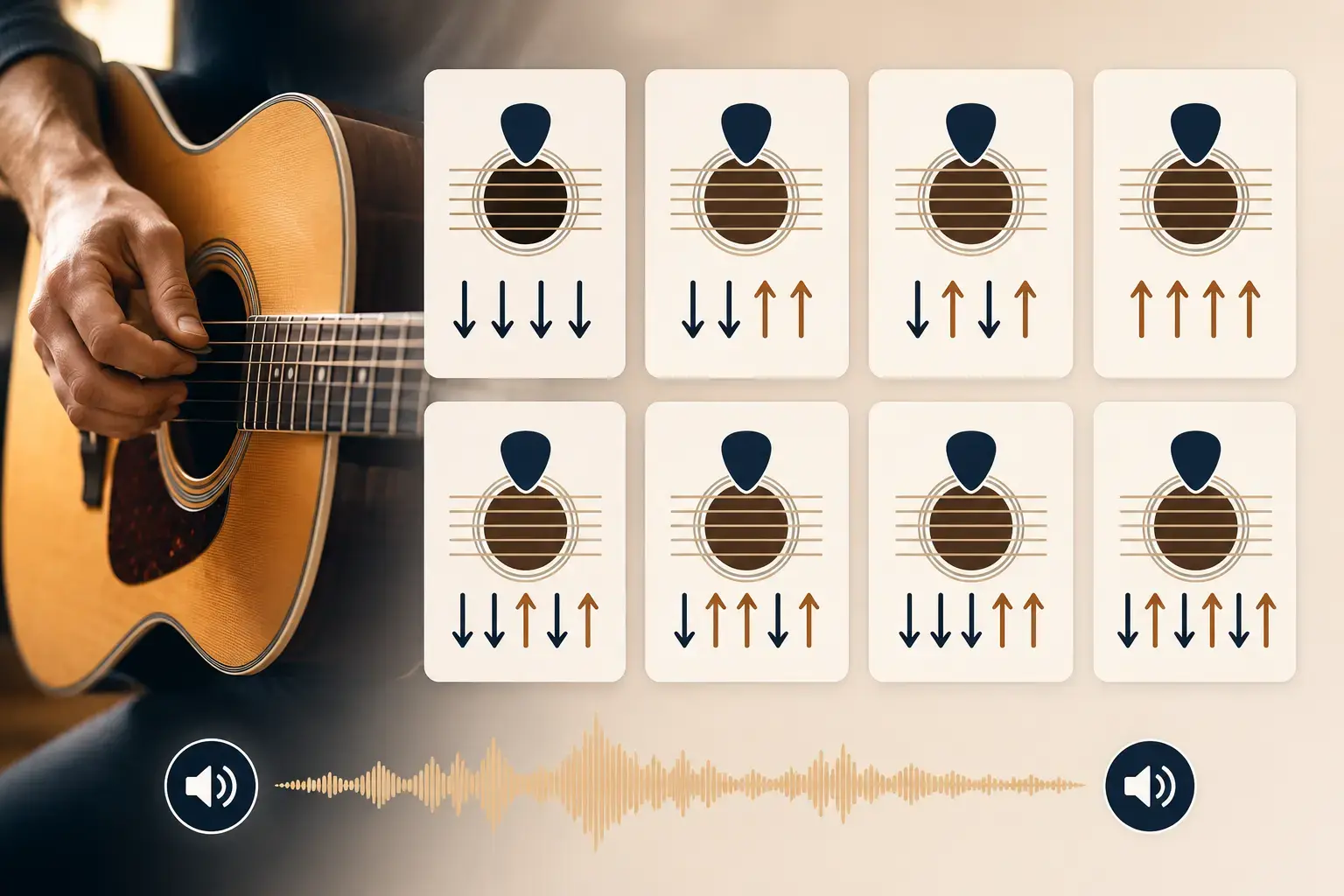
The good news: you don't need dozens of patterns. A handful of versatile rhythms covers the vast majority of popular songs, the stuff you hear in pop, rock, folk, country and worship. Get the eight below down and you can strum your way through thousands of songs.
Every pattern on this page is playable. Hit play and you'll hear it strummed on a real sampled G chord at whatever tempo you pick, with each beat lighting up as it goes. When you want to drill them hands-on, the Strumming Practice tool takes it further with animated up/down guides.
How to Read a Strumming Pattern
Strumming patterns use two symbols, plus a dot for a rest, spread across one bar of 4/4. You count that bar as “1 & 2 & 3 & 4 &”, eight evenly spaced slots:
- ↓ (D)A downstroke. Drag the pick down across the strings, from the low E toward the high E.
- ↑ (U)An upstroke. Brush back up, usually catching only the top 3–4 strings.
- · (rest)No strum. Your hand still moves, you just miss the strings on purpose. This is the whole secret to staying in time.
Counting out loud is the fastest way to get a rhythm into your body. Saying it as syllables is even better, because it turns a bunch of arrows into something you already know how to pronounce. FaChords’ Rhythmic Dictation Trainer builds rhythms out of ordinary words and loops them against a click. It's a nice warm-up before you pick up the guitar.
The golden rule of strumming: your strumming hand never stops. It swings down on every beat and up on every “&”, like a metronome arm. On a rest, it just passes over the strings without touching them. Keep your strumming hand moving, even when you miss the strings, and your timing pretty much fixes itself.
8 Essential Strumming Patterns
Go through these roughly in order, since each one builds on the motion of the last. Press play on any pattern, count out loud (“1 & 2 & 3 & 4 &”) with the highlighted beat, then grab your guitar and match it. Start slow. Only speed up once it feels automatic.
1. Four Downstrokes
One downstroke per beat. That's it. It sounds too simple to bother with, but if this one isn't locked to a metronome, nothing else on this list will be either. Tons of slow rock and pop songs are just this.
2. Continuous Eighths (Down-Up)
Down on every beat, up on every "&". I used to think this was the easy one... until a rock song needed it blazing fast. Then I took a few months off guitar, came back, and couldn't keep up anymore. Speed on this one is muscle, and muscle fades. It's also the pendulum motion every other pattern here is built on, so it makes a really good warm-up.
3. "Old Faithful" (D – D U – U D U)
My favorite, honestly. I learned it on the ukulele when I was first starting out, and it moved over to guitar without changing a thing. It's the most common acoustic pattern out there and fits a huge chunk of pop, folk, and worship songs. The trick is to keep your hand swinging through the rests and just miss the strings.
4. Folk / Country
Old Faithful, but with the gap after beat 2 filled in. It's busier and pushes forward more, which is pretty much what campfire singalongs and up-tempo country want.
5. Pop Ballad
Sparser and more syncopated. Beat 2 is left empty, so the upstrokes end up pulling against the pulse instead of sitting on it. That tug is what makes mid-tempo, emotional songs feel the way they do.
6. Reggae Skank (offbeats)
Only the "&" of each beat, with short upstrokes. Kill the strings the instant after you hit them, and you get that clipped reggae and ska "chk". If it rings out, it's not a skank yet.
7. Punk / Rock Downstrokes
All downstrokes, all eighth notes. Your wrist will complain, but that relentless drive is the whole sound of punk and hard rock. Build the stamina slowly. Your forearm will thank you.
8. Slow Ballad (half-time)
Wide open and patient: a down on beats 1 and 3, then a little D-U lift at the end of the bar. It gives big, ringing chords room to breathe, which is what slow 4/4 ballads (and ones with a 6/8 lilt) need.
Want the animated, full-screen version with more patterns and a built-in metronome click? Open the Strumming Practice tool and drill each one until you stop thinking about it.
Strumming Technique Tips
Drum It Before You Strum It
I've been playing guitar for about a decade now, and the biggest strumming trick I know isn't really a guitar trick at all. It's learning how to drum. Put the guitar down and tap the song out on a table or your lap: a fist hit is a downstroke, a palm hit is an upstroke. Do that with any song you want to jam to. Once your hands can drum it, strumming it is usually the easy part.
Keep Your Wrist Loose
Strumming comes from the wrist, not the elbow or your whole arm. Picture shaking water off your hand. That loose, lazy flick is the motion you want. A stiff, locked wrist makes everything sound harsh, and it wears you out fast.
Strum From a Constant Pendulum
Don't think in individual strums. Think of one down-up motion that never stops. Your hand is always going down on the beats and up on the offbeats. The pattern just decides which of those passes actually touch the strings.
Go Easy on the Pressure
You don't need to dig in hard. A light stroke that catches the strings cleanly sounds way better than a heavy one that yanks the guitar out of tune. Downstrokes can hit all six strings. Upstrokes usually only need the top three or four.
Lock It to a Click
Timing is everything in rhythm playing, so run a metronome or a drum track under every pattern. If you can only nail it without a click, you don't own it yet. You're just borrowing it.
A 15-Minute Practice Routine
Fifteen focused minutes a day beats an hour of aimless strumming once a week. Consistency is what turns these into muscle memory, and as I found out the hard way, it's also what keeps them there.
Common Mistakes to Avoid
Stopping Your Hand on the Rests
The most common beginner mistake by far. If your hand freezes every time there's no strum, your timing falls apart. Keep the pendulum swinging through every rest and just miss the strings. A drummer doesn't stop their arms between hits either.
Speeding Up Before It's Clean
Playing a pattern fast and sloppy bakes in bad timing, and that's a pain to unlearn. Stay at a tempo where every stroke lands cleanly. Only raise it when the pattern feels effortless.
Pausing the Rhythm to Change Chords
Your rhythm hand and your chord hand work independently. Stop strumming to find the next shape and the groove dies right there. Practice slow enough that your fretting hand can keep up without interrupting the strum.
Ignoring the “Feel”
Two players can strum the exact same pattern and only one of them grooves. Why? Accent the downbeats a little, let the offbeats breathe, and listen to the original recording so you copy its feel, not just its arrows.
Start Practicing Now
Strumming is the heartbeat of rhythm guitar, and these eight patterns are behind a ridiculous number of songs. Learn to read the down/up notation, keep your hand swinging like a pendulum, and drill one pattern at a time against a steady click. And if one won't click, put the guitar down and drum it first.
The fastest way to get a pattern into your hands is to hear and see it. Open the Strumming Practice tool, pick a pattern, set a comfortable tempo, and play along until it runs on its own.
Open the Strumming Practice tool →Keep practicing
All Guitar Tools
Free tools for every stage of your guitar journey.